Know what every session costs. Then control it.
Per-request cost is table stakes. Trifrost maps inference calls to sessions, departments, users, and keys — so "what did that cost?" has a number, and "make it stop" has a switch.
"This coding session cost $4.32."
One agentic session is dozens of inference calls — retries, tool calls, title generation, background summarization. Trifrost attributes every call to its session and rolls it up: total cost, per-turn breakdown, tokens in and out, model and provider per turn.
- Session rollup — one number per working session, not 40 line items
- Per-turn breakdown — see exactly which turn burned the tokens
- Utility calls visible — even the hidden system calls (titles, suggestions) are metered and attributed
- Request ID end-to-end — every dollar traces to a signed event row
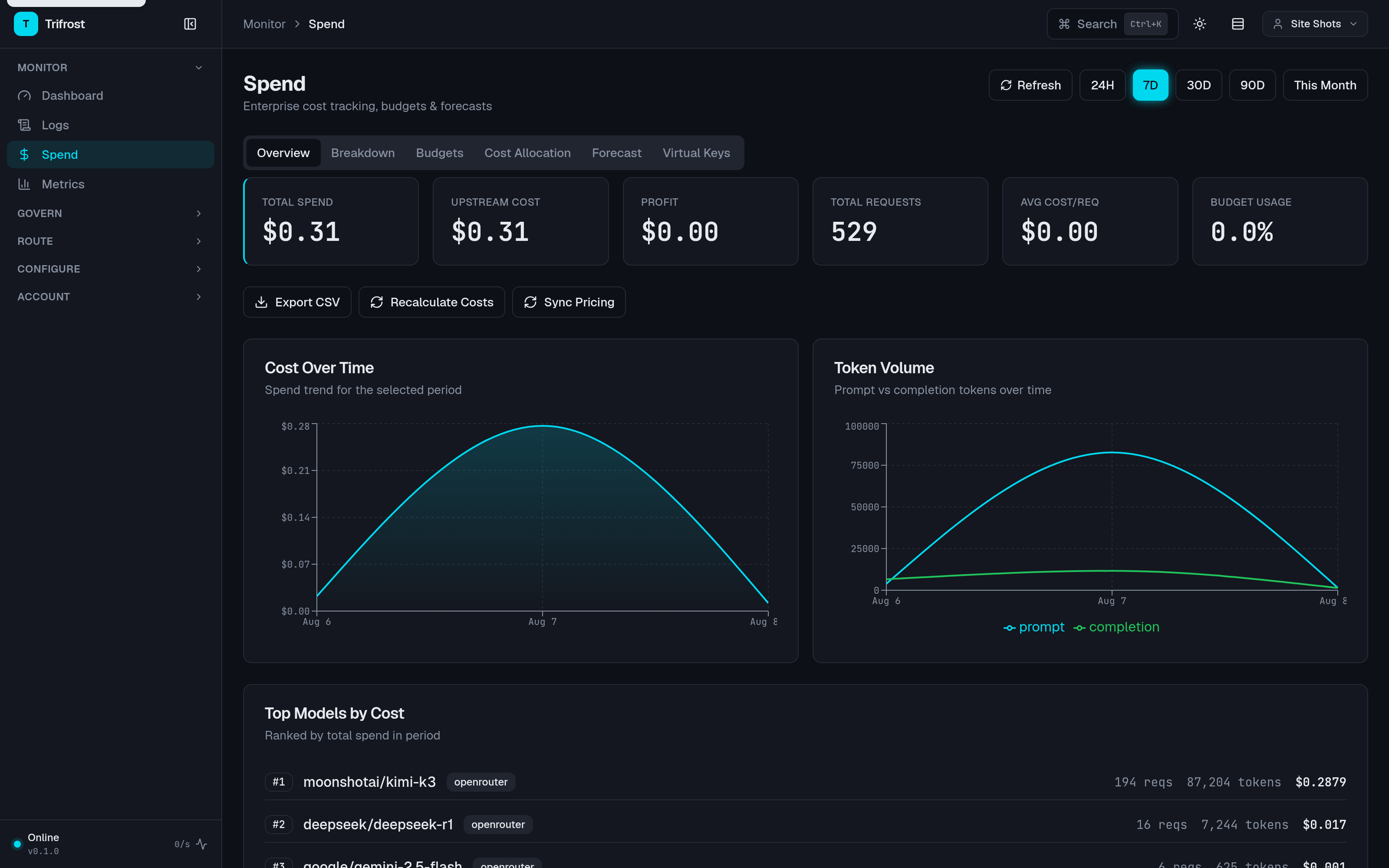
Budgets that enforce themselves.
A dashboard that watches money burn is a dashboard. Trifrost deducts budget atomically at request time — a call that would exceed the budget never reaches the provider.
Per-model budget matrix
Budgets in USD or tokens, per model, at any level of the hierarchy. "Cory: 1M tokens/mo on Opus, unlimited on GLM" is one row of config — not a spreadsheet and a prayer.
Cumulative down the chain
Customer → Department → User → Virtual Key. Every deduction rolls up the chain; any level that runs dry returns a structured 402 budget_exceeded — before a single token is billed upstream.
Fail-closed, zero-latency
Checks run against an in-memory cache — zero DB hits on the hot path. If the budget store can't be reached, requests fail closed. You never discover a spend incident from the invoice.
Dual cost tracking + pricing snapshots
Every request records the upstream provider cost and your marked-up internal cost. Pricing snapshots mean last quarter's numbers recalculate with last quarter's prices — you can defend historical spend even after a vendor repricing.
Forecast the wall before you hit it
Holt's exponential smoothing projects spend with a 95% confidence interval, a budget-exhaustion date, and anomaly detection. Spend alert rules fire with cooldown and a full audit trail of who got told what, when.
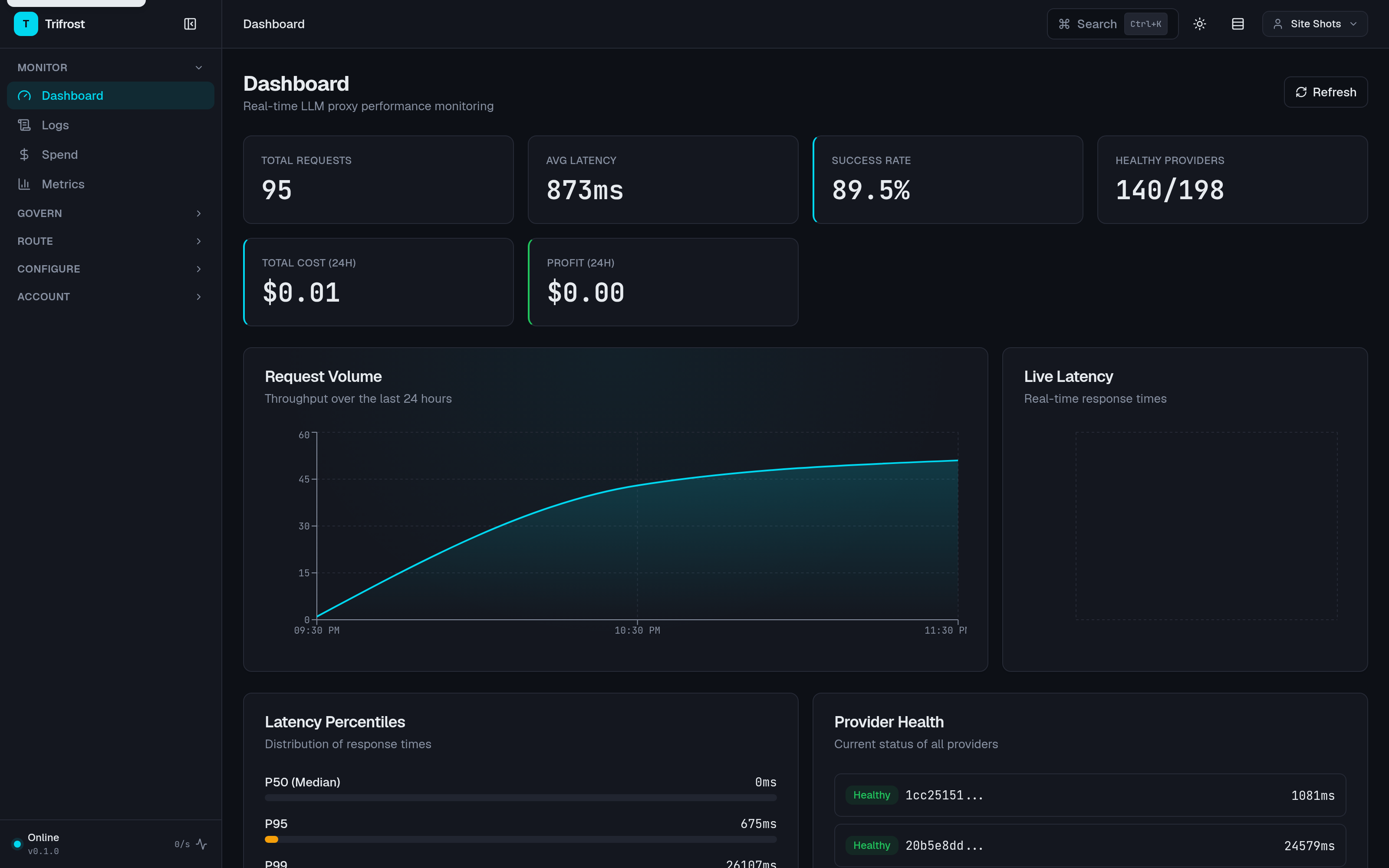
Every dollar has an owner.
Break spend down by provider, model, department, user, or virtual key. Cost and token histograms, model usage rankings, and one-click CSV/JSON export for your finance systems. Department attribution makes chargeback a query, not a negotiation.
- Per-scope pricing overrides — different markup per key, team, or customer
- Cache read/write tokens counted separately, tiered pricing supported
- CSV/JSON export — drops straight into your FinOps pipeline
What does an untracked intern calling Opus all month cost you?
You don't know — that's the problem. With Trifrost it can't happen: the intern has a key, the key has a budget, the budget has a ceiling, and the anomaly detector knows what normal looks like.
Untracked usage
Virtual keys are per-user, hashed at rest, and budget-scoped. There is no anonymous usage — every token has an owner and a limit.
Surprise invoices
Budget-exhaustion projection tells you the date you run out, weeks in advance. Alerts fire before the wall, not after.
Unfalsifiable reports
Every number on the spend dashboard traces to an HMAC-signed event row. Finance can verify, not just trust.